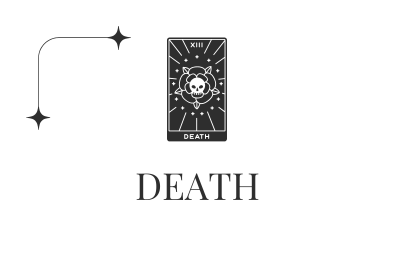

Death – General Meaning in a Tarot Spread
Death – Transition. Ending. Transformation
And that is where we could stop. Once again – Transition. Ending. Transformation. This is the answer. The primary meaning of the card is that the natural end of an existing situation is near. And there is nothing wrong with that. Death is the healing force of life.
The predictive interpretations of this Arcana have always been more positive than negative: favorable changes, perpetual motion, transformation, and liberation from the unnecessary. However, there is a reason for the old Chinese curse: “May you live in times of change!” Life is entering such a “time of change,” and it is entirely unclear when it will return to stable, defined forms. For someone who draws the Death card, a transformation of their old life is inevitable, and almost nothing can prevent it. With Death, processes conclude, cycles close, projects reach their final phase, and the existing is dismantled. Death does not bring immediate success but clears the way for new efforts and a fresh chapter.
Death – The Spirit of Renunciation and Letting Go
Because readings are often performed when the querent harbors hope for something, the appearance of this card – with its resounding “no” – is rarely welcomed. Under Death, plans fall through, goals are abandoned, and projects are consigned to oblivion.
At the same time, Death opens the gates to a new life. At a funeral, this may not always be apparent, but it is always true. Inevitably. What this new life will look like will depend on the surrounding cards. Rarely, Death symbolizes actual mourning, grief, or the sorrow of loss. Sometimes, particularly if the question or situation suggests such an outcome, Death advises acceptance and preparation for the inevitable.
Death – Letting Go of the Past
It may be difficult to let go of what was once so valuable, but it is necessary to acknowledge that the time to say goodbye has arrived. Nothing makes the experience of Death easy, but the beginning of a new era often carries a sense of anxious joy. In a sense, the Thirteenth Arcana is a positive card for those unafraid of change and deep, radical transformation. Its meaning can also be linked to the triumph of a person over themselves.
Just as the Tower signifies inevitable transformation caused by accumulated tension, Death signifies the spaces where tension has already been released – like current that has left a circuit. The querent may feel nothing but relief that something exhausted has finally “fallen away on its own,” or they may be consumed by the bitterness of loss. Either way, it is time to forgive (or to say goodbye) and let go. Death “marks” things that are damaged or no longer viable, things clinging to which serves no purpose. And above all, Death carries the quality of inevitability.
Death – Natural and Unyielding
Death is natural yet uncompromising. It advises consciously letting go of the familiar but outdated, saying, “Finally, it’s over!” and allowing space for something new to emerge in time. The changes it brings are profound and irreversible. Death never errs. If it signals the end of something, it is because that end is necessary for future progress.
Death – Core Meaning
The core meaning of the card is the approaching end of the current situation. A break with the past, the conclusion of the present state of affairs, and the end of life as the querent knows it. The card conveys that something in life is reaching its logical, overdue conclusion. It marks a turning point that may involve lifestyle, work, or relationships. The key to interpretation is to wisely connect the card to the specific question being asked.

Death – Personal State
On the Transience of All Things and the Essence of All That Is Transient
Under the Death card, we are often struck by the feeling that some part of our life has come to an end, and there is nothing we can do about it. A time to embrace, and a time to refrain; a time to scatter stones, and a time to gather them. This feeling might be linked to an empty home after loved ones have left, an empty wallet following losses, the need to change jobs, or health issues forcing an end to an old way of life. The Death card often appears for people reaching a significant life milestone, marking a transformation of personality and a shift to a new phase of existence.
Death – Personal Transformation
When drawn in a personal reading, Death says: Another chapter of your life is nearing completion. A new version of yourself is taking shape – your thoughts, beliefs, feelings, and reactions are all changing. You are becoming someone new, yet still yourself, but in a completely transformed state. New hobbies, a new value system, and new friends and acquaintances will emerge. The only part of you that will remain unchanged is what we call the soul.
At its core, the soul is the only creative force capable of truly building something new and discarding the old. It is the only part of us strong enough to carry out transformation and push us toward spiritual growth. This is the one eternal and immortal part of us that transitions from one life to the next.
Death – Fear of Life
Sometimes, Death appears for those paralyzed by fear of life. They may seek solace in illusions or retreat into their own shell (“How terrifying life is!”). Death can describe someone ready to leave – a job, a relationship, or sometimes even life itself. It carries severity, bitterness, depression, and a sense of loss, disconnection, and detachment.
Under the influence of Death, we sense that the end of a chapter is approaching. We often reflect deeply on the threads of events, the past, and the future – seeing the former much more clearly than the latter. This clarity about the past may lead to futile attempts to breathe new life into what is already beyond revival.
Death – The Person of Death
Death often describes a person capable of significant, and often somber, changes in the lives of others. Such individuals may be well-mannered, impeccably dressed, and quiet – not a Tower-like disruptor, but someone radical in their decisions.
Phrases like “If I can’t have it, no one can,” “I’m dying, but I won’t surrender,” or even a determined intention to “take my enemies with me” (or, for instance, carefully deleting all work files before resigning) reflect the extremes of this personality. This spirit may also appear in subtle ways, which doesn’t make living with them any easier. A hallmark of the Death-person is their lack of joy. This doesn’t mean they are perpetually gloomy or prone to complaining.
They can behave quite appropriately, exude an air of strength and insight, and even possess extraordinary beauty – but something is missing. That missing element is the ability to enjoy life. A person described by the Thirteenth Arcana is a master of leaving, rejecting, destroying, and saying “no.” Their profession may be directly tied to matters of life and death and could be dangerous – for themselves or for others. They are often detached and solitary, with no real attachments or obligations.
In any setting, they feel like a foreign body. Yet, like death itself, they are rarely a “random guest.” If they are present, it’s likely they are exactly where they need to be, even if no one else sees it that way.
Death – Depth and Insight
A person described by the Thirteenth Arcana often possesses keen insight, with a unique ability to perceive truths about themselves and others. They have an extraordinary capacity to see deep motivations and the inevitable outcomes of events.
Death – On a Deeper Level
We Enter Life Through the Gates of Death. This is a beautiful card. Death brings rebirth into true life. Those who have stood on the brink of death understand this deeply. It dissolves all that is false. Death is the Great Transformer, freeing energy from exhausted forms to forge new paths. Death does not kill – it resurrects.
The symbolism of the Arcana prominently features the Mystical Rose of Life on the rider’s banner and the glowing Sun of Immortality on the horizon. One who has died to empty temptations and fears is reborn in spirit, free. This is the journey of Pierre in War and Peace, who, while imprisoned, realises he cannot truly be taken captive.
The absurdity and conditionality of existence become so clear to him that he bursts into uncontrollable laughter. This is a hallmark of initiation. The first thing a person whose consciousness has truly ascended to a higher level does is laugh at how they once viewed the world.
Death – The Duality of Life and Death
Nothing stands closer to life than death. Nothing makes us feel and value life as keenly as proximity to death. They are two intertwined codes, yin and yang, a double spiral. Death is the fruit ripening within us throughout life. Recognising this, we stop perceiving life and death as opposites. All that is new emerges because of the fleetingness of the old.
The theme of Death is integral to the initiation rituals of all mystical traditions. To be reborn into a higher state, one must undergo the purification of finality and bid farewell to something irrevocably. The ability to “die” is the secret of the initiated. The traditional Sufi saying, “Die before you die,” reminds us that we cannot live fully while fear holds us back. Clinging to anything prevents us from being in the natural flow of Life.
Understanding the finite nature of existence is a vital condition for truly living. Death and immortality have always been equally coveted. Mortals have revered the likeness of immortal gods as the highest ideal, while immortal gods became mortal to understand what it means to live. The experience of Death helps us realise that we are only human – capable of sorrow, weakness, pain, and fear.
Death – Death in the Journey of the Tarot
Death is only the midpoint in the sequence of the Major Arcana. What doesn’t kill us makes us stronger. Death signifies the natural transition from one state of existence to another. Something has run its course, “died,” and become unsustainable, making way for a new form of existence. The old must be left behind.
This change may seem sudden, but it is natural. Unlike the Ten of Swords, it is not determined by the querent but rather by the flow of life itself. There is no need to fear it – for those on the spiritual path, this is what they have worked toward.
Death – Complete Transformation
This is a stage in spiritual development where a total break with the past becomes necessary – a transition from decline and shadow into rebirth and a new existence. Death says: forget who you were, for your old life has ended. Ahead lies total metamorphosis, a reconstruction of your way of being, a new style of life. In its upright position, the card indicates expanded horizons and the shedding of limitations. It signifies the end of a current situation, bringing profound changes to the psyche and worldview.
The energy of Death is to destroy our sense of self, which often happens when we face grief, depression, or loss. Tragedy seems absurd and abnormal, leaving us trudging through a shadowy underworld of shifting sands that once seemed like the solid foundations of life.
Yet, in hindsight, we often see these difficult periods as some of the most valuable and transformative moments of our growth. We do what we thought impossible, survive what we thought unbearable. Through this, we feel like a phoenix rising from the ashes. Having endured destruction and helplessness, we grasp the indomitable resilience of the human spirit.
Death – The Symbolism of Death
The card often depicts Death clearing the land around it. Its energy serves as a destructive force, breaking chains and removing completed elements from the present and future with an irrevocable sweep of its scythe.
The number 13 is often seen as unlucky because of the card’s position in the Tarot sequence. The fear of change often overshadows the opportunities that come to those willing to transform their lives.
On the ground cleared by Death’s scythe, regeneration and renewal begin almost immediately. “The red, red blood after an hour is just soil; after two, flowers and grass grow; after three, it lives again.” The number 13 symbolises transformation and rebirth, connecting what is to what will be.
Death represents positive transformation in spiritual growth – albeit often through suffering. The radical Plutonian transformation clears the way for new efforts.
Death – Advice and Warnings
Advice: Let go. Allow something to end. Remove the clutter – internally and externally. Ideally, get rid of it all, even if only “bare bones” remain. Reject old ideals and outdated actions.
Warning: Insisting on unsustainable paths at all costs (“even if it kills me”).
Death – Final Thoughts
Death reminds us that transformation is inevitable, even if we feel unprepared. It opens the door to true light, serving as the bridge between the old and the new. Its motto: “Die and be reborn, rise and move forward.”
As Jiddu Krishnamurti wrote: “We have separated life from death and filled the gap with fear. Yet life does not exist without death.”
Death – Career and Profession
In General: The Positive Side of Death.
Overall, the Death card is beneficial when addressing the end of unpleasant or stagnant situations, or finding a way out of a crisis. However, if the querent is interested in the prospects of a particular business venture, this card suggests that the project risks ending before it even begins. There are stillborn ideas and unviable plans – Death clearly “marks” them, as practical observations often confirm.
Even if efforts are made to advance the project, the resources expended far outweigh the results. It often resembles maintaining a project on “life support” with continuous financial injections, yet no natural development occurs. This only keeps the endeavour “afloat” without any clear purpose. Death highlights steps with no future and roads leading nowhere.
Endings and Letting Go
Death favours the completion and abandonment of projects. Whether this occurs smoothly, painlessly, or with difficulty depends on surrounding cards. The influence of Death is usually natural and logical. Often, the querent can foresee the inevitable conclusion of the situation even before the card appears in the reading. Death merely underscores the finality. It can signify ending professional relationships, leaving a position, parting with business partners, resigning, changing workplaces, or sometimes even saying goodbye to a profession.
With Death, one must prepare to salvage what can be saved or, at the very least, endure challenging times. On the other hand, what replaces the old may turn out to be much better!
What Else Does Death Indicate?
- Stagnation: The inability to grow or progress in the current environment.
- Exhaustion: A morally or creatively depleted project.
- Major Workplace Changes: Examples include bankruptcy or changes in ownership.
- Endings: The card often appears before resignations, layoffs, or job changes.
- Failure: The collapse of plans or projects.
It is relatively rare for Death to signal aggressive events, threats, or large-scale destructive conflicts.
Practical Advice from Death
Death may advise closing a small business and starting a new one elsewhere. For larger companies, it might suggest rebranding or reregistering under a new name.
Professions Associated with Death
The card is linked to professions that exist on the boundary between life and death, such as restorers, grave diggers, surgeons, and even assassins. It can also represent individuals whose work occasionally crosses to “the other side,” such as police officers.
Death – Financial and Housing Situation
Loss of a job or sources of income (this is very typical). A significant change in financial circumstances. This could either mark the end of a difficult period or a decline in income – other cards in the spread may provide further insight. Old investments, methods of earning, and ways of using money are likely no longer viable, and it’s time to look for new opportunities.
Death – Personal Relationships and Love Life
Destruction, Decay, Endings – Love in the Context of the Thirteenth Arcana
The themes of destruction, dissolution, and endings that define the Thirteenth Arcana often manifest vividly in questions about love. The card frequently signals that it is time to part ways and seek a replacement for a relationship that has run its course.
Death typically marks the natural conclusion of a relationship. With this Arcana, there is a chance to part as friends, especially if other cards in the spread do not contradict this possibility. It is also a classic card for divorce, particularly in cases where the relationship has gradually lost its vitality. Death brings freedom – perhaps an unwanted freedom, but as the saying goes, “Don’t look a gift horse in the mouth” (especially this horse…).
In any case, this card signifies the end of a certain phase in life. If the period was marked by the energy of The Hanged Man (helplessness, crisis, despair), then Death delivers good news – this phase is finally coming to an end. If the querent has been agonising over how to achieve a divorce, Death provides a clear answer: now is the time to leave a failed marriage behind, start anew, and build a fresh life.
The Nature of the Endings
Death can reflect both deadened feelings and the fear of losing a relationship that still matters (pay special attention to Cups cards in the spread if they appear). Death highlights “form without content” – for instance, a marriage that technically still exists but has lost its emotional core. A partner described by Death has made a definitive decision to part ways and let go. “Between you and me remains only the wind” (interestingly, a music video with these lyrics is styled with the imagery and energy of the Thirteenth Arcana).
Love and Death: Shakespearean Overtones
Occasionally, Death in a love reading may point to Shakespearean scenarios where love and death are inextricably linked (particularly if supported by other cards). It is also worth noting that Scorpio, the astrological sign associated with the Thirteenth Arcana, is linked to sex and reproductive organs. The connection between “Love and Death” is widely represented in medieval allegories. Love could lead to a dagger in the back or death during childbirth.
Death, in this context, reminds us of the duality of love and loss and the inevitable transformations that come with the end of one chapter and the beginning of another.
Death – Health and Well-Being
This card is unfavourable when it comes to health. The spirit of Death signifies decay and destruction. It can indicate the removal of teeth, surgeries for tumours, various amputations, and medical procedures (“…ectomies”) designed to separate what is viable from what is not.
Under Death, serious health issues may arise, such as surgeries, heart attacks, and similar conditions, as well as chronic and incurable illnesses. In extremely rare cases, it can point to comas or clinical death. However, despite its name, Death very rarely signifies actual physical death of the querent or someone close to them.
Death often reflects states of depression. Meditating on this card can help cope with loss or joyless changes, especially if they are linked to stress. Occasionally, it may indicate curses or the evil eye.
Death corresponds to conditions such as atrophy, menopause, the cessation of certain functions, or the end of natural rhythms.
Death – Reversed
Reversed Death can signify that the end of a matter is near but has not yet arrived, or that the person is resisting its arrival. Reversed Death resists the changes that the upright Death card typically brings. It resembles someone with a toothache who keeps delaying their visit to the dentist.
With reversed Death, we refuse to let processes or situations come to their natural conclusion, finding it difficult to let go. Resolving a problem (at least definitively) becomes extremely challenging under this card.
Key Traits of Reversed Death
- It brings pain without relief.
- Changes are either partial or too slow.
- Stagnation, inertia, and temporary inaction dominate.
In a reversed position, the card symbolises fear of change, stagnation in affairs, prolonged life changes, and the discomfort and inconveniences associated with them. If surrounded by positive cards, it can indicate slow but steady progress toward positive changes.
Energy of Reversed Death
Reversed Death carries an energy of weakness, passivity, and malaise. It suggests a state of inertia, curses, or negative influences – “sleepwalking through life” – and sometimes dabbling in supernatural forces, no matter how they manifest.
There is also an interpretation that reversed Death may point to a situation where danger has been miraculously avoided.
Additionally, it can serve as a warning that the person may be trying to “cut away” something that shouldn’t be removed.
Death – Manifestation of the Card in Combinations
With The Fool – A risky undertaking.
Death and The High Priestess – A bad omen.
The Emperor and Death – Can indicate a financial crisis, the collapse of a business, or the dissolution of a company.
With Strength – A forced necessity to let go or abandon something under pressure.
With The Hanged Man – Futile attempts to hold onto something or preserve what is slipping away.
With The Tower – Intensifies the power and speed of transformative forces. This combination can foreshadow accidents or injuries.
With The Moon – Depression, apathy, and exhaustion.
With Reversed Moon – Drowning (according to an old interpretation; older interpretations tend to focus on the literal meaning of Death, which is why its combination with The Hanged Man, for instance, paints a stark picture).
With The Sun – Success after a crisis.
After a Reversed Ace of Wands – A health threat due to overexertion (stroke, heart attack).
With Eight of Wands – Speeds up the ending and transformation.
With Five of Cups, Eight of Cups – Enhances the sense of loss and the closeness of an ending.
With Four of Swords – Hospitalisation.
With Five of Swords – Renewal (according to Hajo Banzhaf).
With Seven of Pentacles – An unexpected treasure (according to an old interpretation).
Death – Archetypal Correspondences
Death – Symbolic Connections
- The Scythe: Represents cutting away the old to make space for the new, often tied to the inevitability of endings.
- The Skeleton: Symbolises the impermanence of the physical body and the enduring nature of the spirit.
- Mystical Rose: A symbol of eternal life, featured on the banner of the rider in traditional decks.
- The Rising Sun: Seen on the horizon, it symbolises rebirth and immortality after transformation.
- The White Horse: Represents purity and the inevitability of death’s transformative journey.
Death – Astrological and Planetary Associations
- Scorpio: The zodiac sign of transformation, intensity, and rebirth.
- Pluto: Governs deep transformation, destruction, and regeneration.
- Saturn: Symbolises endings, structure, and the passage of time.
Death – Numerological Significance
- 13: Represents transformation, a bridge between the old and the new, often misunderstood as unlucky due to its disruptive nature.
Death – Mythological Parallels
- Hades (Pluto): Ruler of the underworld, overseeing transitions from life to death.
- Osiris: Egyptian god of the afterlife and resurrection.
- Kali: Hindu goddess of destruction and rebirth, embodying the cyclical nature of life and death.
- The Grim Reaper: A Western archetype of death as a skeletal figure wielding a scythe.
Death – Psychological Archetypes
- The Transformer: A force that dismantles the old to create space for growth and new beginnings.
- The Shadow: A confrontation with fears and resistance to change.
- The Phoenix: Rebirth through the ashes of destruction.
Death – Emotional Resonances
- Fear and Resistance: A natural reaction to change and endings.
- Relief and Release: Letting go of burdens to embrace new possibilities.
- Renewal and Hope: The promise of rebirth after the closure of a cycle.
Death – Symbolic Pairings and Dynamics
- With The Fool: A risky new beginning or drastic change.
- With The High Priestess: Hidden or unsettling truths revealed.
- With Strength: Letting go under pressure, the courage to release.
- With The Sun: Triumph and renewal after a period of crisis.
- With The Tower: Intensified destruction and rapid transformation, potentially catastrophic.
Themes of the Death Card
- Endings: Natural closures, often necessary for progress.
- Transformation: Profound internal and external change.
- Rebirth: New opportunities emerging from the ashes of the old.
- Acceptance: The need to let go of resistance and embrace change.
Death is a reminder of life’s cycles – an ending is never final, but a precursor to renewal and growth.
Over to you…
Now, let me know in the comments: Do you have any personal observations about Death Major Arcana? How does it typically manifest in your tarot readings?
Leave a Comment