
The sword of the victor is forged in solitude.
The Hermit – The Path of Truth
The Hermit is one of the most profound cards in the Tarot. Look at the Hermit in the deck – you will see what the Path means to its creator, what self-knowledge signifies, and what truth represents. The Hermit is sacred. The first task of a person on earth is to know, understand, and accept oneself. Most troubles in life stem from the fact that people know themselves poorly and don’t know how to deal with themselves. They replace inner truth with external impressions and treat this matter with immense presumption on the basis that “this person” (meaning themselves) has belonged to them since birth, and therefore they believe they know themselves well and understand themselves correctly.
“Diogenes with a lantern” is a symbol of seeking inner wisdom and the need for light to reach one’s goal. He has nothing except what he carries within himself, and the only thing he desires is to find the truth. Almost all religions contain legends of spiritual journeys, of great teachers or prophets who have traversed the world in search of divine truth. This truth has nothing to do with ideology, temporary needs, or personal preferences.
It represents a moment of spiritual self-improvement when one must detach from temptations and everyday needs and retreat into the wilderness in search of their soul, the meaning of existence, and their God. Divine power rarely speaks clearly to someone who is drowning in concerns and worldly attachments. Honest pursuits of truth occur in solitude and bring divine inspiration. “The spirit brought you into the wilderness; the spirit will lead you out.”
The lantern symbolizes our own knowledge, which must be used to illuminate the path of our search. The staff symbolizes God – a support in the search and protection along the journey. Free from temptations and seeking only truth, the Hermit is an allegory of the experience of self-initiation. Across the threshold of the Hermit’s sanctuary, even if it looks like a barrel, lies the boundary of all kingdoms. The wise Alexander understood this at the age of twenty, and when, on the return journey, his companions mocked the philosopher in the barrel, he said: “If I were not Alexander, I would be Diogenes.”
The Hermit – General Meaning in a Tarot Spread
The Hermit has gained a reputation as a card foretelling loneliness and “generally nothing good,” whereas for spiritual development, this card is a true treasure. However, this is an aspect that tends to frighten the average person rather than inspire them. For this reason, the Hermit is rarely a welcome guest in a reading. In essence, though, it speaks only of staying true to oneself. Its appearance may suggest that your approach to life has become overly emotional and involved, and now it’s time for “healing” – a return to the true path, closer to yourself and your authentic nature. This isn’t just a question of beliefs or conscience – the Hermit differs from the Hierophant in that it isn’t about concepts or societal norms. It’s about your core.
The Hermit represents authenticity that lives deep in your being, the spirit rather than the letter. It isn’t about what “should” be done; it’s about who you are and why you cannot act otherwise. This is not merely the “I” or the super-ego but the truest, most authentic self without any adaptive facades. Nothing separates us from others and from this strange world we’ve learned to navigate as much as our authenticity – our loyalty to ourselves.
The Hermit emphasizes the desire to withdraw, the need for self-analysis, finding inner peace and personal truth, and following one’s own path. It signals that it’s time to reevaluate your life, your goals, and your relationships. It’s a time to step back from social life, petty concerns, and routine distractions that block deeper reflection on your soul. Everyone needs a period of solitude – a “hermit’s retreat” – to finally understand themselves. However, this is more than just a time-out. The Hermit’s vibrations far exceed those of the Four of Swords. They herald a moment of finding your inner center and your unique light. The primary message of the Hermit is to stop relying on others’ opinions and to reject anything that goes against your internal sense of what is true and right, even if it means going against societal expectations. This is a card of spiritual independence and immense personal strength, enough to walk your narrow path, even without companions or public approval.
In a reading, the Hermit often represents someone who has stepped back from involvement, is “pedaling backward,” and is protecting themselves from external influences. They need time to sort things out and solidify their decisions. Pressuring or rushing them is futile – they will act when and how they deem fit. If Justice is nearby, they’re unlikely to make a wrong decision about what’s right or wrong. The Hermit’s essence lies in self-knowledge, standing firm in one’s convictions, and resisting external influences, be they persuasive words, threats, cajoling, or manipulation. If these influences don’t align with their understanding, the response will be, as they say, “like a crocodile reacts to a turnip.” Trying to accelerate events or exert pressure will be pointless.
For the Hermit, the focus is on defining their position and boundaries. Outwardly, this may manifest as silence – no calls, no letters, no proposals, and no refusals. They are deciding what everything means to them, why they need it, and how far they are willing to go in matters of love, business, or anything else. This introspection is often the most critical aspect.
Like the High Priestess, the Hermit indicates hidden truths. Justice seeks truth, while the Hermit seeks a deeper reality, emphasizing that truth and reality are not the same. And the Hermit finds it because you find what you seek.
The Hermit often points to something hidden, but more as something lost or concealed rather than a mystery. The Hermit loves seclusion – wells, fountains, caves, cellars, and secret compartments appeal to its essence. Sometimes the Hermit represents the search for (and discovery of) a teacher, mentor, or spiritual guide, or receiving valuable advice.
In older interpretations, the Hermit can signify not only spiritual but also literal journeys, especially to spiritually significant places.
As a symbol of the past, the Hermit represents not so much loneliness as the desire to draw a line under something and leave it behind. Whether the temporary solitude it predicts leads to a better life will depend on the surrounding cards.
The Hermit lends strength and focus to concentrate on what truly matters, though this “matter” may well be inner achievements rather than goals outlined in a planner. The Hermit is not about external activity – it often signals a withdrawal from it. Rarely does it promise progress in superficial matters. However, Gugenheim notes that it is “a card of wisdom, achievements, and accomplishments.”
The Hermit is slow-moving, so its appearance in a spread may indicate delays in the process.
Ultimately, the Hermit suggests setting aside petty problems and distractions that prevent focus on the soul. This is the time to pay close attention to your inner self. Everyone needs a period of stepping back from the mundane and others. This card encourages you to try being a Hermit for a while to understand yourself, your needs, and your issues. It’s necessary to learn to see yourself objectively, evaluate your development honestly, and learn to love yourself. Remember, those who cannot love themselves cannot love others. Time spent in stillness, solitude, and contemplation is not wasted. Calm analysis and reflection on your plans will help you avoid future mistakes.
For the average person, such as a woman asking, “Will he come back?” or “Will I marry soon?”, the Hermit signifies solitude, at least for the near future, with a negative answer to “everyday” questions. Yet, the card also advises using this solitude productively – grow during this time. For “non-everyday” questions, the Hermit is a strong and important card, akin to a lantern illuminating a difficult path. However, for those focused on spiritual growth, the Hermit may indicate loneliness from having outpaced former friends and loved ones. They stayed behind while you moved forward. The Hermit can now only connect with other Hermits, but there may be few nearby. Returning to the past halts spiritual growth. Instead, this card urges you to keep climbing toward new peaks, where you will find new companions.
In reverse, the Hermit may indicate that the woman won’t remain alone. For spiritual seekers, however, it suggests that the peak has not yet been reached (perhaps the path taken was incorrect) and that creative solitude is absent and not yet foreseeable.

Much knowledge brings much sorrow.
The Hermit – Personal State
Serious and self-reliant (provided the individual isn’t entirely new to the spiritual path and has adapted somewhat to the Hermit’s energy; otherwise, it can feel confusing or even depressive). “I’m thinking. Please do not disturb” (writing a thesis, attending therapy, finishing a project, journaling…). The Hermit lives by their own rules. Their focus is directed inward rather than outward, pursuing internal goals with indifference to external achievements. This is not the Charioteer who seeks self-discovery through external actions but a solitary exploration of the depths of the soul and the ascetic existence of a Hermit.
Spiritual independence and walking one’s own unique path – where there are no companions – are central to the Hermit. They seek their own truth, not what is socially desirable. The Hermit’s tendency to withdraw and turn inward is not born of fear but of a thirst for knowledge and self-discovery. This is productive solitude: immersion in the inner world, detachment from material reality, the hustle of daily life, and the needs of modern civilization. It is a form of inner focus, not for worldly pursuits but to seek the eternal. What could we possibly achieve in the external world if we were not given our own inner realm?
The Hermit guards this realm with the same zeal as the Emperor protects his external domains and conquests. Often, this card reflects a fear of exposing secrets (especially if the Moon appears alongside it, signaling a well-founded fear). The Hermit is adept at “hiding” – you’re unlikely to find them on social media; at most, you’ll stumble upon a generic, impersonal profile. This person carefully shields their true self from others, avoiding contact for fear that their solitude will be disrupted. They seem born with the existential awareness that we are all alone – birth, death, pain, and revelations all leave us alone with ourselves. For the Hermit, however, solitude inspires thought, offers depth and peace, and is one of the most rewarding states. For those unaccustomed to the Hermit’s energy, this may seem impossible.
The most mystical aspect of the card is the lantern. To discern its light is the spiritual challenge of the Ninth Arcana. The Hermit does not suffer from helplessness, disappointment, or despair. They know who they are, what they’re doing, and why – or at least, this is the state the Arcana urges one to attain.
Key qualities of the Hermit: prudence, caution, insight, serious intent, reason, the ability to compose oneself at the right time (especially alongside Strength), and emotional self-mastery. The Hermit embodies protection, independence, spiritual self-sufficiency, wisdom, and secrecy. They exude a calm patience and understated demeanor. Even someone with striking looks may consciously downplay their effect. The Hermit is unconcerned with socialization. Their adaptation to society can be superficial – like a “desktop wallpaper” that looks conventional but doesn’t open properly due to non-standard extensions or missing connections. Such is the Hermit, regardless of gender, age, rank, or status. The cloak in the Hermit card symbolizes the blurring and concealment of their physical and social identity during their solitary spiritual ascent. Yet, the Hermit’s lantern sometimes becomes a guiding light for others.
The Hermit represents inner work, self-reflection in solitude, and the pursuit of isolation for spiritual progress. Self-sufficiency is another key term for the Hermit. However, it can sometimes reach a point where the individual is so enclosed in their personal world that they become almost unreachable. The Hermit is fundamentally independent of others and largely unaffected by their approval or disapproval, as their sole measure is their personal life philosophy.
The Hermit symbolizes a seasoned initiate who has learned deeply from life’s lessons. Often, it represents someone whom fate has “removed” from the chaos of life for a time – perhaps they spent years in a hospital, lived in seclusion, or worked in a closed institution. The Hermit is drawn to spiritual practices and fasting. They never become part of the crowd. Their calling, curse, and gift is their absolute loyalty to an inner truth. Not whims, not intellectual reasoning (which may conflict with that truth), not societal norms, nor even the strengths and weaknesses of their own character – but only the guiding force of their soul. The Hermit is akin to the Fool, but while the Fool has all paths open, the Hermit sees only the narrow, thorny road to the stars. Whether paved with jewels or lined with barbed wire, it is the same path. Symbolically, the Fool’s stick and bundle become the Hermit’s staff – a tool for their solitary journey and a source of support.
This person often exhibits detachment, pronounced introversion, restraint, and seclusion. The Hermit may simply be old – not necessarily in age but in rigidity, inflexibility, alienation from others, spiritual frailty, and a categorical rejection of the modern world. Some people seem to begin their midlife crisis directly after their adolescence. At its best, the Hermit represents someone so rich in inner treasures that the outer world seems no more than tinsel and trinkets – weighty but lacking true value. They set purely internal goals, sometimes spanning lifetimes.
Negative traits include self-satisfaction within a bubble of knowledge – perhaps ancient and esoteric but unused in practice. Bitterness, isolation, depression, and an aura of sorrow or loss may manifest. Through the theme of seclusion and secrecy, negative traditional meanings such as hypocrisy, deceit, and even betrayal can arise.
The Hermit – On a Deeper Level
A Stage in Spiritual Development. The Hermit symbolizes the Saturnian retreat into oneself – a journey into the desert or the monastery of the spirit, into the Twelfth House. The Hermit seeks God within, searching with an unrelenting flame for the invisible foundation of their existence, the origins of life and the future. Essentially, the Hermit is seeking purpose – what it truly should be. Knowledge leads to action, but until the Hermit’s aura has been cleansed and begins to shine with a new light, their face remains hidden, and they remain silent. The Hermit must first illuminate their soul with beauty before it can become a guiding light for others. In total solitude, they accumulate and concentrate potential energies that will one day create a new reality. This card symbolizes the synthesis of possibilities, a “sacrament of an actual but hidden birth in which only spirit and soul participate.”
From a Kabbalistic perspective, the Hermit represents the ninth Sephirah, the foundation that gathers all previously revealed attributes (Names) of God and concentrates them before projecting them into the material world (the tenth Sephirah). Energies, patiently and silently accumulated in isolation, away from external distractions, are unleashed with tremendous power when the time comes. The Hermit descends into darkness to find their inner light. Often, the light of their visions and revelations continues to guide others spiritually for centuries.
The Hermit’s mystery lies in the search for truth, existential reflection, the discovery of inner treasures, and the quest for wisdom and knowledge within oneself. It involves self-initiation, contemplation, and profound insight into the essence of things, guided by an inner mentor.
Religions worldwide tell of spiritual journeys, great teachers, or prophets who traveled across the world or retreated into the desert in search of enlightenment and truth. The Hermit reflects self-initiation, the pursuit of hidden wisdom, and ancient knowledge – not practical survival skills.
This card reminds us of the connection between the celestial and earthly realms, symbolizing the merging and unification of the higher and lower worlds. Since the inner and outer realms mirror each other, aligning oneself with the celestial requires retreating into the depths of one’s own inner world.
“This is the desert. But in this desert, God speaks to me. That is why I live in silence – to hear Him.” The Hermit embodies absolute loyalty to personal principles and inner knowledge. They are indifferent to external opinions, societal judgments, or conventional stereotypes of thought and behavior. This card calls for deep analysis, reflection on past experiences, and a reassessment of spiritual truths. It represents following one’s own path, delving into one’s inner world, exercising moderation and confidence, and embracing self-restraint and wisdom.
The Hermit’s journey is one of real selfhood, marked by solitude in the Twelfth House, where there is only the light of one’s internal truth. It involves turning inward and refraining from processing external information. This may be a time to reevaluate one’s life, connections, and goals. Any resulting changes are indicated by surrounding cards.
The Twelfth House is a house of secrets, and the underlying motive for self-isolation is often the protection of one’s inner truths. These are not casual secrets to be shared over drinks but profound truths about who one truly is. In a spread (especially alongside the Nine of Wands), the Hermit, much like the High Priestess, suggests the presence of hidden truths. It implies caution and detachment from worldly concerns. It also signifies a triumph over passions and a desire to understand the inner nature of events.
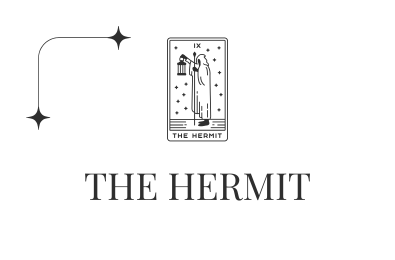
The Hermit is typically depicted as an elderly figure, leaning on a staff and cloaked in a monk’s robe with a hood. In their hand, they hold a lantern, partially obscured by the sleeve of their cloak. This symbolizes the light of esoteric knowledge, which always remains partially hidden. Esoterically, the Hermit guards ancient wisdom from the uninitiated. Their staff symbolizes knowledge, the only true support for a person. Sometimes, the mystical staff is divided into seven sections, subtly referencing the seven sacred centers of the human spine. The Hermit follows the path of initiation, mystery, and knowledge.
The Hermit is closely tied to the Moon. Their knowledge is not based on rational logic or intellectual constructs but is instinctual and truer than any mental frameworks. It delves into the mystical origins of existence, descending into the underworld where Persephone (Virgo) resides, Orpheus finds and loses Eurydice, and Dante contemplates the other side of immortality. Linked with the Moon, the Hermit represents higher tantric practices of enlightenment, transformed into religious devotion and asceticism (e.g., celibacy).
The Ninth Arcana is associated with the Virgo sign, symbolizing the organization of internal resources in the present to create a fertile foundation for the future. Virgo’s qualities of service, selflessness, and sometimes incredible corruption are echoed in the Hermit. These attributes can coexist within the same person. The Hermit represents understanding the order of life’s manifestations and the reasoned will to learn self-discipline and comprehend the sequence and harmony of the universe. The Hermit is the card of detachment from the world, representing the journey inward.
This is a period of introspection, where we “close off” from external influences to find peace and, most importantly, rediscover ourselves. The Hermit symbolizes pivotal moments of self-discovery, showing us who we are, what we strive for, and how to achieve it. The Hermit bridges two poles: the deepest emotions and the highest understanding. Those who follow the Hermit’s call do not lose themselves but instead gain clarity, strength, and harmony with their inner being.
Aleister Crowley highlights the Hermit’s connection to Virgo, describing it as the “hidden Persephone,” the queen of Hades, who in autumn leads the soul of the world into the underworld and in spring brings it back to rebirth. It is no coincidence that the following card is the cyclical Wheel of Fortune.
The Hermit – Career and Profession
The Hermit is indifferent to honors and wealth, remaining fully focused on their goal. Professionally, the Hermit corresponds to freelancers who are not tied to any organization and often harbor a certain aversion to working in teams.
This card is favorable for intellectual pursuits such as research, analysis, writing academic works, memoirs, or even maintaining a blog. It embodies persistence and consistency but only when the person finds meaning in their efforts.
The Hermit represents individuals whose professions involve searching and investigating. This could include scientists, archivists, or even criminal investigators following a trail with their metaphorical lantern, illuminating what others have missed or hidden (prosecutors and lawyers, however, fall under the Justice card). It may also represent teachers, consultants, and mentors.
The Hermit is quite auspicious for education (his lantern symbolizes the light of knowledge) and travel (as he is typically depicted as being on a journey, his staff symbolizing a traveler’s tool). The Hermit often signifies refining professional skills, either independently or under the guidance of a senior mentor. Ziegler mentions that this card can represent wise leadership, though likely not in business ventures heavily focused on profit.
For businesspeople, the Hermit is unfavorable. It often indicates the futility of their current endeavors, acting as advice to abandon the current enterprise and pivot to something new.
Some interpretations suggest the Hermit symbolizes completion and harvesting results. However, the Hermit is more aligned with the journey and process itself, with the focus being primarily on inner rewards and discoveries.
Under the Hermit’s influence, a person may question the meaning of their work or their professional suitability. Sometimes, this card signals a withdrawal from active professional life, retirement, or the transfer of accumulated wisdom to others.
The Hermit – Financial and Housing Situation
The Hermit is an unfavorable indicator for financial matters. He lives detached from worldly possessions and suggests the querent practice the same. This card represents financial restrictions, receiving less than what is due, reduced salaries or pensions, and a simple, ascetic lifestyle. If the situation involves agreements, they may be canceled. The Hermit may advise the querent to simply detach from financial concerns and view the situation from a different perspective, implying that money is not the most important thing.
The Hermit – Personal Relationships and Love Life
Loneliness is a rare commodity. It’s equally hard to attain when it’s desired and to let go of when it’s no longer wanted. When appearing in a spread, the Hermit suggests that the querent, even if in a relationship, is currently more focused on themselves and their personal growth than on anything else. Traditionally, the Hermit is considered an unfavorable card for relationships. Relationships often thrive on adapting to another person.
The Hermit does not adapt. He follows his own path and truly belongs only to it. Therefore, this card often predicts walking away on one’s own path, separation, breaking up, or at least seeking greater independence and autonomy from a partner. Among other things, it can indicate canceled weddings or broken engagements (though other cards would need to confirm this). The Hermit contemplates the meaning of relationships, their purpose, and whether they align with his inner sense of life’s path. On the positive side, the Hermit approaches things seriously and won’t overlook relationship problems, hoping they’ll “sort themselves out” (he knows problems usually “sort themselves out” as per the Tower).
The downside of the Hermit is that he is unlikely to actively resolve the problems he perceives – he will instead withdraw (“to sort out his feelings”) and, once he has, will walk away on his own path. You can rely on him for joint problem-solving, such as draining swamps, clearing obstacles, and building bridges, but only if you help him see some fundamental meaning in it. Then he becomes a serious and reliable partner, someone you can count on. But the lack of meaning exhausts him, making him a difficult partner – it’s much easier to provide care, material stability, and sexual variety than to figure out and turn the key to a mysterious and unknown lock hidden somewhere deep within him. However, once that key is turned and meaning shines through…
The Hermit can endure the absence of care, stability, and variety (as mentioned above) and much more – he thinks in existential terms and won’t complain about inconveniences.
The Hermit is secretive. In some ways, he resembles the High Priestess. Part of his private life will always remain a mystery. He could represent a naturally reserved partner who shares very little (at best, “a teaspoon per year”), or he may have something to hide (such as infidelity). This card often points to detachment, distance, and emotional withdrawal.
The Hermit is quiet. He doesn’t express his feelings excessively. He takes relationships seriously, but monogamy, for him, is already “too many people.” While a lonely individual may dread going home to an empty house, the Hermit treasures solitude and closes the door to his private sanctuary with deep relief, finally becoming himself. The thought of losing this sanctuary by entering into marriage frightens him far more than it inspires him (“You’ve had enough drama during the day, then you come home – and there you are!”). The Hermit accepts the inconveniences and worries of loneliness philosophically, not giving them undue importance – after all, “everyone has their own burden to bear.” The famous lines by Omar Khayyam, “It’s better to starve than eat what’s unworthy, and better to be alone than with the wrong company,” take on special resonance with the Hermit – here, the word “better” is superfluous because he can hardly imagine doing otherwise. For him, loneliness isn’t an event – it’s simply his state of being. This card often reflects a conscious desire to be alone. For the Hermit, honesty with oneself and inner harmony are of utmost importance. Until he achieves them, rushing him is futile, and he won’t accept anyone’s influence. Anything that doesn’t align with his nature and individuality will inevitably be destroyed or excluded from his life (or, more likely, never even allowed into it). Traditionally, the Hermit signifies celibacy, reclusion, withdrawal from the world, and a secluded, self-contained life that others often find unfathomable.
It’s particularly significant if the Hermit appears for someone in love. This is a clear signal to take a step back, avoid rushing into a commitment, and take time to examine feelings. This card symbolizes detachment, caution, and deliberation in choosing a partner, as well as inhabiting one’s personal space. Most likely, the person approaches relationships seriously but needs time to understand what they truly want because clarity is not yet present. Diving in headfirst is not advisable.
The card may indicate a lack of sexual desire, but this is not always the case. For example, the Hermit might be “discovering himself” sexually, and outside assistance is not necessarily implied. Sometimes, the person finds themselves to be their best sexual partner, experiencing with others nothing comparable to what they achieve alone. “Solo love” may be practiced to varying degrees, ranging from basic to sophisticated. If paired with the Hanged Man or the Tower, this may involve suppressed libido manifesting in crude self-satisfaction. However, if paired with Strength or the Seven of Cups, the Hermit’s self-exploration may bring unparalleled pleasure that no one else can match.
Convincing a Hermit to engage in shared intimacy is no small feat, and expectations of fireworks may need to be adjusted. This partner is restrained and unlikely to take the initiative, though some may find such qualities appealing. Often, the card signifies coldness, the ability to do without sex, or a complete absence of intimate life.
At its best, the Hermit can signify an emotional (though rarely sexual) connection with a spiritually enlightened and deeply wise individual. This is a union of profound depth.
The Hermit – Health and Well-Being
The Hermit is not the most favourable card for health. It signifies the body becoming ephemeral (“Dust thou art, and unto dust shalt thou return”).
This card indicates a decline in energy, reduced vitality, and the gradual winding down of life’s functions. It represents a descent inward and movement into depth. In its most classical sense, it corresponds to the processes of natural ageing and physical frailty. However, it can also signify exhaustion following overexertion and the necessity to conserve remaining energy.
Key health issues include depression, insomnia, hormonal deficiencies, menopause, and rheumatism. It also reflects chronic health problems typical of advanced age, as well as digestive issues.
The Hermit is often associated with anaesthesia, the effects of sedation, and the “winding down” of mental activity.
Advice: Embrace asceticism and let go of your usual lifestyle and everyday habits that have become pseudo-needs.
The Hermit – Reversed
Sometimes, it is believed that a reversed card does not change its meaning, but intuition suggests otherwise. At times, the reversed Hermit signifies the inability to maintain solitude, something the person values deeply. They are prevented from withdrawing and focusing; their meditations are repeatedly interrupted. The struggles described by this card are familiar to an introvert stuck at a corporate party they cannot leave early. The reversed Hermit is offered drinks, drawn into conversations, invited to dance, enduring all of this stoically while counting the minutes and inwardly crying out, “God, why me?” They would gladly trade it all for a deserted island right now.
This card may also indicate a lack of wisdom or prudence – or, conversely, unnecessary precautions and unwarranted suspicion. On the whole, the reversed Hermit suggests a person who lacks clarity or sound judgment. It can also point to someone learning the wrong lessons, searching in the wrong places, or heading in the wrong direction. False ideals and poor advice, presented as profound wisdom, fall under this card’s meaning. Its traditional interpretations include deceit, lies, hidden fraud, corruption, and concealment.
Depending on surrounding cards, it may also signify refusing help, stubbornness, suspicion, perpetuating an unproductive lifestyle, or excessive secrecy and caution.
Occasionally, it highlights extensive knowledge that proves difficult to apply in practice – wisdom accumulated over time that is simply irrelevant in the current context. It represents an imperfect perfectionist, an ascetic who succumbs to self-indulgence, a mentor unable to embody their own teachings, a defrocked monk, a burnt-out helper in a “caring profession,” or someone long overdue for retirement but clinging to their laurels.
The reversed Hermit may also show motivation to pursue relationships, but, unfortunately, this is often driven by fear – such as a fear of growing old alone – rather than genuine love. They dislike being alone, but there is no guarantee they will find happiness with someone else. It can signify “loneliness together.”
The Hermit – Manifestation of the Card in Combinations
The High Priestess – A bad omen, associated with another woman and infidelity, or a secret related to her.
The Sun – Revelation of infidelity, uncovering secrets.
The Empress – A sign not to rush events, even if something is dissatisfying. Everything will unfold in its own time.
The Lovers – Weakens the Hermit’s influence, pointing to sexuality or the emergence of relationships, sometimes against the person’s desire. Also represents deep inner focus before taking a step into the new. Great inner composure and reliance on personal values are needed.
The Devil – A struggle of motives, temptation to act against oneself or to go against one’s nature.
Judgment – Unjust judgment (from an old interpretation). Receiving significant news. A major event, marking the beginning of a new life chapter.
The World – Reduces the Hermit’s sense of isolation, integrating them into the flow of events.
Four of Swords – Amplifies the Hermit’s inertness and contemplative tendencies.
Seven of Swords – Strengthens the Hermit’s themes of solitude and seclusion.
Two of Cups – Weakens the Hermit’s effect, involving the person in relationships or connections.
Eight of Cups – Intensifies the Hermit’s introspection and the search for deeper meaning in events.
Nine of Cups – Self-indulgence and selfish pleasures.
Reversed Ten of Cups – Many troubles and challenges.
The Hermit – Archetypal Correspondences
The Hermit – Archetype
- The Seeker of Truth
- The Sage or Wise Elder
- The Solitary Wanderer
- The Mystic or Ascetic
- The Inner Guide
The Hermit – Mythological Associations
- Diogenes – Searching for an honest man with his lantern, symbolising the pursuit of truth.
- The Buddha – Renouncing worldly attachments to achieve enlightenment.
- Hermes Trismegistus – Guardian of hidden wisdom and esoteric teachings.
- Orpheus – Journeying into the depths of the underworld for revelation.
- Moses – Receiving divine guidance in solitude on Mount Sinai.
- The Hermit Archetype – Found across cultures as the spiritual seeker withdrawing from society for self-discovery.
The Hermit – Psychological Themes
- Introspection and inner reflection.
- Detachment from external influences.
- Seeking authenticity and self-awareness.
- A period of retreat and reassessment of one’s life path.
- Embracing solitude as a means of transformation.
The Hermit – Astrological Correspondences
- Virgo – Represents refinement, analysis, service, and inner discipline.
- Saturn’s Influence – Symbolising wisdom through limitation and introspection.
The Hermit – Element
- Earth – Grounded exploration of self, material detachment, and practical wisdom.
The Hermit – Key Symbols
- Lantern – The light of inner truth, guiding the way through darkness.
- Staff – A symbol of support and stability, representing inner strength.
- Cloak – Protection and a veil of secrecy, preserving sacred knowledge.
The Hermit – Spiritual Path
- The journey inward, discovering divine truth within.
- The process of personal alchemy: transforming the mundane into the spiritual.
- Learning to walk the path of solitude and wisdom with resilience and grace.
The Hermit – Lessons
- Seek your truth beyond external validation.
- Understand solitude as a gift, not a burden.
- Use the time of withdrawal to grow spiritually and emotionally.
- Trust your inner light to navigate life’s challenges.
The Hermit – Shadow Side
- Isolation and excessive withdrawal from the world.
- Fear of connection or engagement with others.
- Stagnation in self-reflection, leading to over-analysis and inaction.
- Cynicism or detachment from worldly responsibilities.
The Hermit and Jung’s Archetype of the Wise Old Man
The Hermit card in the Tarot strongly resonates with Carl Jung’s archetype of the Wise Old Man. This archetype represents the inner guiding figure, a source of wisdom, insight, and transcendental knowledge that emerges when an individual is ready for deeper self-discovery and spiritual growth.
In Jungian psychology, the Wise Old Man often appears as a mentor, sage, or teacher, symbolizing the journey toward individuation – the process of becoming whole by integrating all aspects of the self. This archetype does not provide simple answers but instead illuminates the path toward self-awareness, helping individuals confront the mysteries of existence and their true nature.
The Hermit embodies this archetype through his retreat from the outer world to seek inner enlightenment. With his lantern symbolizing illumination and the staff representing support and authority, he is a guide who encourages introspection, urging us to delve into the depths of our psyche and uncover hidden truths. The Hermit’s solitude is not an escape but a deliberate withdrawal to connect with the eternal wisdom within.
Key Attributes of the Wise Old Man in the Hermit:
- Wisdom and Guidance: The Hermit is a beacon of light in the darkness, offering profound understanding without dictating choices. Like Jung’s Wise Old Man, he teaches that true wisdom comes from within.
- Spiritual Mentor: The Hermit helps individuals navigate life’s trials by prompting self-reflection and personal accountability, much like the Wise Old Man archetype, which serves as an inner spiritual guide.
- Bridge Between Worlds: Both the Hermit and the Wise Old Man symbolize the connection between the material and the transcendent, encouraging the seeker to look beyond the physical and explore the spiritual realm.
- Shadow and Self-Integration: The Hermit, like the Wise Old Man, invites individuals to confront their shadow – the unacknowledged parts of themselves – and to integrate these aspects into a cohesive and authentic whole.
- Patience and Solitude: Both figures highlight the importance of solitude as a tool for personal growth and the cultivation of insight. They stress that enlightenment is a journey, requiring patience and perseverance.
Lessons from the Wise Old Man Archetype:
- Seek Knowledge Through Introspection: Answers to life’s profound questions lie within, and true understanding comes through self-exploration.
- Balance Wisdom with Action: The Wise Old Man is not static; his wisdom fuels meaningful decisions and actions in the external world.
- Embrace Solitude as a Gift: Times of solitude are opportunities for spiritual renewal and deeper connection with the self.
- Recognize the Eternal Teacher Within: The Hermit’s light reminds us that the ultimate source of guidance is our own higher consciousness.
The Hermit and Jung’s Wise Old Man archetype serve as reminders that the path to wisdom is often solitary but deeply fulfilling. They encourage seekers to trust their inner voice, embrace the lessons of the journey, and find strength in their connection to universal truths.
The Hermit is both a guide and a student, representing the enduring quest for knowledge, meaning, and self-realisation. It challenges us to embrace stillness, trust in our journey, and light the way for others once we’ve found our truth.
Over to you…
Now, let me know in the comments: Do you have any personal observations about The Hermit Major Arcana? How does it typically manifest in your tarot readings?
Leave a Reply to Temperance – Meaning Major Arcana Tarot Card MeaningCancel reply