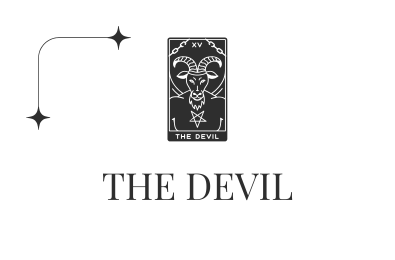

The Devil – General Meaning in a Tarot Spread
In its simplest sense, The Devil indicates that the person has lost control over the situation in question and may bring a lot of trouble upon themselves.
The Devil indicates that somewhere, the person has entered a path of self-destruction and degradation (or such a prospect exists). It warns that by indulging in their weaknesses, the querent is crossing acceptable boundaries. Or that there is an abuse of power (any kind of power, including erotic), and this too is essentially indulging in one’s weakness. Alternatively, there is a strong subordination to someone or something, and this will lead to nothing good. The Devil points to an overwhelming situation where a personality or a weakness gains too much control over us, taking away our freedom and normal self-expression. This can also be simply a harmful external influence. Ultimately, we start doing exactly what we shouldn’t be doing. This is the Devil’s main trick – making someone behave in a way that is directly contrary to what would be beneficial for them.
Of all the Tarot cards, The Devil is the hardest to understand because it is different for everyone. Waite believed that the primary manifestation of The Devil was fear, while other authors emphasized the awakening of base instincts, and others think it represents a dark past to which a person is somehow dependent. The common aspects for all interpretations are probably the situation of dependence on someone or something, weak will, a shameful failure of good intentions, and actions performed against one’s own beliefs. The dark side of all things – the specifics of which will be shown by other cards.
To avoid straying from the interpretation (and The Devil has a direct relation to straying from the path), it’s important to remember what happens when a reading is done. Tarot is a wise and insightful Friend. By showing The Devil in the reading, this all-seeing friend warns: how your mind is acting right now is leading to the destruction of order, steering your life in the wrong direction. There is a huge temptation to ignore the rules, to stray from the true path under the influence of temptation, fear, or other pressures. Primarily – to cut corners, not practice patience and hard work, and indulge your whims. The Devil deviates from Temperance, and it all ends with The Tower. One way or another, this card shows that we are playing with fire. On a deep level, it means that our question touches, first of all, the shadow sides of our personality, or that there is clearly some bad influence in the situation.
Most often, The Devil represents a feverish obsession with something (a strong passion that harms business obligations, losing one’s conscience because of desire, the temptation of dishonest gains, and similar things).
In general, the appearance of The Devil can be seen as advice to urgently return to the right path and a warning that persevering in what this card symbolizes will lead to severe consequences. Sometimes, it’s impossible to reverse course (such as in the case of heroin addiction). While there is still a choice, it’s important to walk away without looking back.

The Devil – Personal State
“Obsessed by a petty demon.”
And sometimes by a medium or large one – the scale can be indicated by other cards. The person is under the influence of an obsessive idea, fear, or another strong emotion that has a destructive effect. This stage in spiritual development symbolizes an encounter with one’s own shadow, the dark aspects of one’s personality that secretly control us. It is a trial through which one can see the most involutionary parts of their nature, parts they do not want to accept, or even if they do accept them with open arms, they still do not know how to control them.
The Devil indicates that the person may be preoccupied with some malicious intentions – seeking revenge, kidnapping, seducing, or even killing. A VERY characteristic feature of The Devil is that the person doesn’t think about the consequences of their actions. The world, thoughts, and life seem to end for them at the point where this will be carried out: “I will seduce, take control, get revenge, deal with it… and then whatever happens.” After this, their thinking stops because the subtle demon behind the person will fully manifest in this goal and will disappear, needing nothing further from the person. The person will be left to deal with the consequences. The Devil always involves an element of internal weakness (internal, because outwardly the person may seem extremely purposeful, and the goal is usually the “Devil’s goal”). There is self-indulgence, a huge dependency on one’s desires, passions, and cravings. In a horoscope, this is often indicated by the position of Lilith – what is called a “weak spot,” through which the person tends to degrade, showing their corruption, weakness of will, or lack of principles. Lilith can vary in strength and manifest in different ways depending on the sign, house, and aspects. The same can be said for the Fifteenth Arcana. For some, it is a shameful fear and trembling, while for others, it is the temptation to sweep everything in their path, leaving no stone unturned, letting everyone else fear it. For some, it is more related to cruelty and destruction, for others, to the unchecked sexual impulses. The Devil equally fosters both pathological attraction and pathological avoidance. For some, The Devil is more pleasurable, for others more tormenting, but in either case, everything has its price. In some cases, the person clearly sees that it is “horror in the dark.” But as a tempter, The Devil most often appears in an attractive guise. It is precisely this difficulty in fighting and resisting that makes it so challenging.
In the worst case, The Devil indicates falling into a self-destructive enslavement to harmful addictions, temptations, habits, and dependence on them. From here comes the element of a lack of principles – promises to rid oneself of these passions are usually just words. In general, the morality of the person described by The Devil is highly questionable, and trusting them is not recommended for your own benefit. The Fifteenth Arcana can indicate guilt for illegal actions (and which articles they fall under may be indicated by other cards).
The Devil often speaks of servile sensuality, dependence on personal comfort, which can manifest as excessive greed for luxurious things, drug addiction, obsession with sex, or simply as an overwhelming laziness. Another very common meaning of The Devil is dependence on another person.
Sometimes, The Devil simply encourages doing something extravagant, showing off, experiencing something “exciting”… or simply “being like everyone else,” not falling behind in the world.
The Devil – On a Deeper Level
How Lilith illuminates the dark or weak side of every zodiac sign it enters, the Devil also personifies the dark side of other cards (especially those adjacent to it in the spread): For the Magician, it represents black magic; for the Priest, hypocrisy, greed disguised as piety; for the Lovers, power struggles or the degeneration of a relationship into lust with no trace of love; for Justice, corruption or the inability to admit one’s own wrongdoings. It represents the opposite, dark side of Strength, immoderation in contrast to Temperance, and governs various areas of the Moon. But most significantly, it is a dark parody of the Fifth Arcana (The Hierophant) – what, essentially, are you worshiping and serving?
This is a struggle between Higher Good and Higher Evil (and they can look quite nontrivial at this high level!). Evil is a constituent part of both human nature and life in general, and here the choice is made not for order, but for chaos. Individualism, the refusal to submit to cosmic order, the thirst to follow one’s own path – this road leads nowhere.
The figure of the Devil is a symbol of magical forces of astral light or the universal mirror, in which divine forces reflect in reverse, or a lower state. This card is also connected with the concept of astral light as a universal creative force, astrologically corresponding to Mars (the planet exalted in the sign of Capricorn). The inverted pentagram (five-pointed star) symbolizes the principle of active spirit descending into matter, as well as the degradation and destruction of the spiritual essence in man. Bat wings emphasize its association with the night or shadow realm, and the animal nature of man is expressed in the male and female principles, shackled to a cube on which the Devil sits. His torch is false light, leading unenlightened souls to their own destruction. They are shackled in free chains – they can cast them off, but they don’t. These “black lovers” are held by illusions, not real chains. This, by the way, is the source of hope – the chains can be thrown off. One simply needs to find the desire to do so. People don’t do this because they don’t want to.
Capricorn is associated with the goat-horned Pan – the ancient god of immoderation and frenzy; he was not evil, but the sounds of his flute would stir people and bring them into uncontrollable madness. Ideally, a person should be able to see the Devil and not fear interacting with him (in psychological terms, one must understand their shadow). The Devil’s main trick is to make one believe he does not exist. In the inner world, this looks like the feeling of one’s own sinlessness, righteousness, and freedom from all lowly things, weaknesses, and dependencies. Spiritual teachers of all religions, including Christianity, have warned against this throughout time: do not think of yourself as sinless, do not think of yourself as strong.
The Fifteenth Arcana often exposes the “superman complex,” the Luciferian theme of primacy, pride, arrogance, self-assurance, and vanity. It tempts with “self-realization” in many areas, self-promotion – it doesn’t matter where or how, just to be noticed. It fosters the need to surpass others, to defeat someone, to prove one’s superiority.
Sometimes it triggers excessive socialization, dependence on one’s ego, and the ego’s dependence on the opinions of others. The Devil is the “prince of this world.” And the world, to a large extent, shackles a person. People become what the “this world” accepts them to be, forcing them to fight for their existence in the image and likeness of the jungle.
The ancients taught that there is an order for the world, in which all living beings can find their best purpose. The divine law establishes and maintains this order. The Devil seeks to overthrow it. The true path through Tarot is to approach divine power. At this stage of development, the traveler is strong and initiated enough to become a valuable servant of the forces of evil. At this point, the decision must be made whether to continue along the path toward the ultimate goal or take another road (which begins here and ends here). The temptation is great – Temperance offers patience and modesty while waiting for tasks to be completed, and the Devil shows a way to achieve the same goal without waiting and without work. What is offered is vast, but the price is even higher. In reality, one CAN achieve all of this without the help of the Devil. He is just interested in the servant and their potential. Looking at the Fifteenth Arcana in the spread, one should remember that Tarot is a living guide to the world of transformation and growth, and by showing the Devil to a person, it tries to help realize the danger or prevent a harmful mistake. Right now, a quick solution to problems and instant gratification is offered – without work, waiting, morality, etc. It reminds you – impatience will lead to the collapse of all plans and hopes, and the dark forces of involution benefit from this. They do not need a successfully developing free person; they are interested in stopping and entangling the hero in their nets. For the power or pleasure the Devil offers, one must pay a steep price, and personal freedom will be the first to go. Everything is leading to the fact that this way, chaos will reign in life, with inevitable unhappiness, suffering, loneliness, and the most unfortunate circumstances. Those seeking shortcuts will face devastation and fall, calamities, and self-destruction, even if golden mountains are promised to them now.
On astrological associations, we find the following material: the number 15 (Fifteenth Arcana) is connected with the full moon, the 15th lunar day. The Moon is the planet of the immortal soul. Dying and being reborn on the horizon, it awakens in the human soul the idea of immortality and is associated with the image of the heavenly Eye, observing the Earth at night. But at night, everything earthly is plunged into sleep, and the watchful Eye has no one to share what it sees with, it only watches, saying nothing. But its sight is sharp and penetrates the darkest corners of matter, understanding its essence and foundation. To preserve the old while giving birth to the new is the Moon’s traditional function. And the dense matter, where this memory is recorded, is the responsibility of Capricorn. One can say that if Sagittarius affirms a new vision of the world, Capricorn, as its compensation, is attached to the old, to the most rigid and conservative foundations of it. Therefore, the Devil card (astrological equivalent – Capricorn) is associated with serving matter, which brings internal (spiritual) emptiness.
Some authors consider the Devil in a spread to be a symbol of a test, a “challenge,” an exam a person must pass to test their strength and ascend to a new level of self-awareness and awareness of the world. This test or trial can be anything – a risky enterprise, a decision to escalate a conflict, or, indeed, alcohol, drugs, or marital infidelity. The focus is that the test must be passed, it must be consciously faced – and if the card is upright, this will contribute to growth and liberation from temptations in the future. If it is reversed, the person either won’t pass the exam (they’ll back down or fail), or they won’t be able to free themselves from the dependency they’ve entered, at least not in the near future.
In its most positive interpretation, the Fifteenth Arcana is Hern, the green god of nature and the forest, representing the instinctive and sexual nature of man. Since man has learned to deal with unconscious forces, their manifestations have been regarded as demonic and dangerous (the church played a significant role here). Hern calms, conquers the instinctive nature, brings it back to Earth, and teaches respect for it. Hern is primarily a male deity, in charge of male sexuality and the ability to procreate. This is a very interesting, though rarely highlighted, aspect of the Arcana. Hern is the father and the god of fatherhood. He embodies the thirst for life and instincts that allowed the human species to survive. This includes both the sexual instinct and the egoistic belief that we are at the center of the universe, as well as the desire to control everything in our own interests. Attempts to deny this and suppress the powers of Hern are self-destructive. Of course, this morality contradicts Christian morality, and Hern’s horns became the Devil’s horns. It was noted earlier that the Devil is a dark parody of the Hierophant. However, it should not be overlooked that attempts by priests to completely ignore the imperatives of Hern often turn them into a dark parody of the Devil, and the problem of obsession with temptations and desires takes such a prominent place in their lives that the average European, secretly considering Viagra, might marvel. Hern carries an immense reserve of life force, which should be enough for everyone’s survival. He stands guard over life, not relying on our shaky ideas about its value. The temporary blurring of the mind of human children by instinctual urges is carefully and foresightedly provided for by Father Hern. It is not for children to decide – whether the human race will survive from millennium to millennium. This is a serious issue, not to be taken lightly. Therefore, instincts, despite all resistance and suppression, assert themselves at a certain point in life and demand to be heard and directed. And ideally, Father Hern, standing by every cradle, should not be cursed but revered and thanked (the eternal disagreement between Christianity and paganism).
The Devil – Career and Profession
The Devil occasionally indicates that a person must undergo a test of strength and intelligence to reach the heights in their field. But far more often, it signifies a situation where someone has “sold their soul” to something and has fallen into submission, from which they cannot escape. This can manifest in various ways, and the area of impact can be practically anything. It could equally apply to show business, finance, science, or politics. There is often a significant dependence on another person, or immense pressure. The situation forces one to make decisions that, sooner or later, will lead to serious regret, and that moment may already have arrived.
The Devil warns of the risk of betraying one’s beliefs, falling into dependence, being compromised, or falling prey to clever manipulation. It indicates the inability to act according to one’s own will. The Devil rarely describes an openly hostile situation – it usually appears under an attractive guise, and on the surface, everything may seem perfectly respectable (a good illustration might be the film The Firm). It can involve involvement in dubious enterprises that may end badly. A tangle of dark machinations, a web of lies and intrigues, problems with violating professional ethics. This could involve data falsification, mutual complicity, theft, shady deals, circumventing hierarchy, leaking confidential information, or corruption – in short, “a little dirt in the ointment.” Often, being caught in such a “web” of questionable dealings is followed by ruthless exploitation or obsession with further advancement. Hence, the Devil can indicate a workaholic who forgets everything else in life.
Engaging in disreputable activities – the scope of meanings is wide, from black magic to prostitution, to any form of fraud, from “cure-all” healing courses to political advertising production. Professionally, the Devil is closely tied to politics and usury. Bad advice. A struggle for power.
The Devil may also foretell an unexpected failure in business due to someone’s scheming or a fateful turn of events.
The Devil – Financial and Housing Situation
When the main question of the reading concerns material well-being, the Fifteenth Arcana manifests relatively positively, promising its achievement, although most likely not through the purest means. The Devil is a symbol of gain and corruption, mercantilism, and the charging of interest. It speaks of a concentration of efforts solely on achieving material wealth, a strong desire for material, purely physical well-being, and a fixation on the “good life.” However, as they say in Odessa, seeing a pie, having a pie, and eating a pie are three very different things. There is also the clear risk of degradation in the pursuit of these things. The Devil manifests in profiteering at the expense of others, enrichment at someone else’s cost.
It signals falling into a situation of dependence and submission (a typical situation for a kept person). Additionally, it denotes an insatiable craving for continuous acquisitions.
Financial manipulation. Speculation.
The Devil – Personal Relationships and Love Life
“Obsession with the little devil.”
Sometimes with medium or large devils – the caliber can be determined by other Arcanas. The person is under the control of some obsessive idea, fear, or other strong emotion that is having a destructive effect. This stage in spiritual development symbolizes the confrontation with one’s own shadow, the dark aspects of one’s personality that subtly control us. It’s a trial during which you can see the most involutionary parts of your nature, which you don’t want to accept or, even if you do embrace them, you still don’t know how to control them.
The Devil can indicate a person carrying harmful intentions – seeking revenge, abducting, seducing, or even killing. A very characteristic feature of the Devil is that the person does not think about the future consequences at all. The world, thinking, and life seem to end for them at the point where their goal is achieved: “I will seduce, take control, get revenge, kill… whatever happens next.” Thinking stops at that point because the subtle demon controlling the person has fully “realized” their goal and disappears, no longer needing anything from them. However, the person is left to deal with the aftermath. In the Devil’s influence, there is always a sense of internal weakness (externally, the person might appear determined, with a goal that is “devilish” in nature). There’s self-indulgence, a huge dependence on desires, impulses, and addictions. In astrology, this is usually marked by the position of Lilith, the “weak spot” through which a person is prone to degradation, exhibiting their corruption, weak will, or lack of principles. Lilith’s strength and manifestation vary depending on the sign, house, and aspects. The same can be said for the Fifteenth Arcana.
Sometimes the Devil can point to karmic inevitability, something hidden and predetermined. Apart from the symbolism of temptation and violence over the light nature, the Devil (like Lilith astrologically) holds a karmic meaning – fate, destiny, doom. This is often forgotten, although it’s emphasized in older interpretations. The presence of the Devil in a reading makes the circumstances fateful, even if not inherently corrupt. Its appearance indicates the presence of destiny hanging over the situation. Sometimes the Devil signals that a deep, passionate connection between people was formed in the past, and now, karmic conditions have reunited them. But the foundation of this connection is dark, and in the past, there were huge difficulties, possibly hatred, violence, unfulfilled promises, fatal vows, the use of magical charms, or something similar. And now, these two constantly stir up each other’s old wounds.
The Devil significantly energizes the realm of instincts. One of the reasons it’s difficult to get out of relationships described by the Fifteenth Arcana is the intensity of sexual experiences. Drowning in the sea of passion, a person may be fully aware that they are stuck deep, and it would be wise to escape, but they have no idea how to do so. Sometimes the card indicates that there were magical charms involved, and this “obsession” arose due to manipulations aimed at binding someone. One partner plays with the other like a cat with a mouse, deliberately or unintentionally, using tricks to tie, possess, get back, dominate, or take revenge – the list of desires continues. The Devil can also indicate a connection where love and hate are simultaneously present and in high concentration. There is uncontrollable attraction, as well as great hostility (a desire to be rid of the other and a fear of losing them, no freedom… in general, typical manifestations of Lilith). Hence the constant battle, with peace only a distant dream, if there’s time to sleep. These relationships need light, and some release, because right now they are sticky, painful, essentially power-driven, with a strong focus on themes of power, submission, inability to resist, and inability to stop in time. One should not underestimate the danger they pose.
The reaction to the Devil’s gifts largely depends on the person’s relationship with the “mirror” Arcana – the Hierophant, or their moral principles. When these are undeveloped, the person sees the Fifteenth Arcana as a lesson, something fascinating, “a source of happiness,” and they drown themselves in it, sometimes even justifying it with a philosophical or psychological base (which further confirms the old rule: the Devil is a parody of the Hierophant). If the conscience is developed, then what happens under the Devil’s influence is unequivocally seen as a dark phase and loss of one’s will. The person clearly feels that all of this – passion, mania, obsession, instincts – makes them act against their own will. The identification with the shadow does not happen, and neither does its joyful acceptance. The Devil remains an oppressor and enslaver.
The Devil can also point to complex feelings related to the termination of a painful relationship – such as divorce, during which the relationship reaches a point where all unflattering feelings are exposed. Crossing all boundaries of decency can happen easily, no matter how polite someone might think they are.
The Devil – Health and Well-Being
Sometimes the card indicates negative astral influence, black magic actions (although this usually requires confirmation from other Arcanas, for example, the presence of The Hanged Man).
Destruction (or at least undermining) of health due to addictions, bad habits, an unhealthy lifestyle, self-indulgence. Drug addiction, alcoholism. Venereal diseases.
When confirmed by other Arcanas – death.
The Devil – Reversed
The reversed card usually carries positive meanings: liberation from dependencies and fears, shedding of chains, overcoming obstacles, the beginning of spiritual understanding, and the dissolution of a toxic connection. The person begins to free themselves from illusions or, in good faith, resists an overpowering personality, situation, or their own weaknesses. In the realm of spiritual knowledge, the reversed card signals that the person has recognized the limitations of material forms in comparison to the boundlessness of their own soul.
For someone who typically behaves in the manner of the Fifteenth Arcana (the seducer, deceiver, etc.), the reversed card may signify a true catastrophe, exposure, retribution, and the loss of power.
The Devil – Manifestation of the Card in Combinations
It is believed that if the Devil appears surrounded by good cards, it may suggest an undesirable situation in which one can successfully “dodge” retribution.
With The Fool – some authors believe that The Fool weakens the influence of the Devil, bringing freedom from dependencies and materialism.
With The High Priestess – a bad omen.
With The Chariot – new opportunities open up to achieve the desired, no direct unpleasantness threatens, but when making a choice, one must carefully consider the consequences.
With Justice – it’s not the time to search for “the whole truth,” some time must pass to restore justice, and it won’t happen now anyway.
With The Star – is considered to definitely weaken the influence of the Devil. Overcoming fears, temptations, and uncertainties, but not through willpower, but through true purity of nature and the protection of higher powers.
With The Sun – a sign of a devilishly charming personality, capable of enchanting to the point of obsession, instantly causing uncontrollable affection and willingness to serve their interests. Blinded by passion and delight, ready to follow a very dangerous person to the ends of the Earth. The person is indeed charismatic and not without positive qualities. But they are truly dangerous, in every sense.
With The Judgment – ruinous legal costs.
With The Four of Wands – it is believed that this card also brings freedom and weakens the negative influence of the Devil.
With The Seven of Cups – a bad combination, indicating excessive dependence on something (sex, alcohol, gambling, etc.), squandering money, and uncontrolled self-indulgence.
With The Ten of Cups – the card weakens, “denies” the influence of the Devil, bringing joy and peace.
With The Eight of Swords – ignorance, fear of the unknown, limitation; the person doesn’t even suspect that they are bound hand and foot.
With The Nine of Swords – complete despair.
With The Two of Pentacles – depression.
The Devil – Archetypal Correspondences
Keywords
- Temptation: Desire, lust, indulgence.
- Addiction: Overcoming personal boundaries and self-control.
- Shadow Self: The darker, repressed aspects of the personality.
- Manipulation: Control, coercion, and deceit.
- Dependency: Emotional, financial, or psychological reliance on external forces.
Symbols on the Card
- Chains: Bondage, physical and emotional restrictions, limited freedom.
- The Devil: The embodiment of temptation and fear, representing the darker aspects of the psyche.
- The Figures: Subjugated people chained, suggesting psychological enslavement or false power.
- The Pentagram: The symbol of materialism, physical indulgence, and the material world’s dominion over spirit.
- Fire and Darkness: Destruction, temptation, and loss of control.
- The Two Figures: Representing the duality of human desires, the conflicting attraction to darkness and light.
Astrological Correspondence
- Capricorn: The Devil is closely associated with the zodiac sign Capricorn, which represents ambition, control, and material success, often at the cost of spirituality.
Mythological Archetypes
- Pan: The Greek god of lust and unrestrained desire, embodying wild energy and sexual impulses.
- Lilith: The first woman in mythology associated with rebellion, darkness, and sexual autonomy.
- Hades: The god of the underworld, symbolizing the darker side of life and the soul’s journey into shadow.
Psychological Archetypes
- The Temptress/Temptor: The part of the psyche that leads to self-destruction through indulgence and manipulation.
- The Addict: A person whose life is consumed by the pursuit of desires or dependencies.
- The Shadow: Represents repressed fears, desires, and the unconscious mind’s darker side.
Related Tarot Cards
- The Lovers: Represents temptation, difficult choices, and the struggle between the higher self and the shadow.
- The Hanged Man: A point of surrender and sacrifice that leads to the confrontation of inner darkness.
- The Tower: Sudden disruption or collapse of the illusions created by The Devil, bringing clarity and awakening.
- The Fool: Innocence and a lack of awareness that may lead to the tempting path of The Devil.
Positive Traits
- Acknowledging and confronting your shadow self.
- Gaining awareness of your temptations and addictions.
- The ability to break free from emotional or psychological bondage.
- Overcoming manipulation and reclaiming personal power.
- Embracing authenticity and self-realization.
Shadow Aspects (Reversed or Challenging Position)
- Entrapment in destructive behaviors or patterns.
- Excessive indulgence and loss of control.
- Toxic relationships based on power, manipulation, or codependency.
- Avoidance of personal responsibility or self-awareness.
- Deception, lying, or self-sabotage.
Practical Applications
- Reflect on areas where you feel trapped or controlled and take steps toward liberation.
- Examine unhealthy dependencies, whether emotional, financial, or physical, and work toward self-sufficiency.
- Recognize patterns of temptation or addiction and actively resist them.
- Seek to break free from toxic relationships or environments.
- Embrace honesty and self-awareness, confronting the darker aspects of yourself to move forward.
The Devil serves as a powerful reminder of the seductive nature of desires and the importance of maintaining personal freedom and self-control. By confronting our shadow selves, we can break free from the patterns of temptation and manipulation that limit us.
Over to you…
Now, let me know in the comments: Do you have any personal observations about The Devil Major Arcana? How does it typically manifest in your tarot readings?
Leave a Comment